Overview
What is Lexi?
Lexi is an AI-powered English learning platform designed to address the challenge of limited real-world speaking practice environments. It enables learners to practice speaking without fear of making mistakes, available 24/7.
Core Benefits
- Learn Anytime — No scheduling required; practice 24/7 at your own pace
- Personalized Feedback — Receive accurate guidance tailored to your proficiency level
- Safe Learning Space — Practice without pressure or judgment
- Cost Effective — High-quality learning at an affordable price
System Architecture
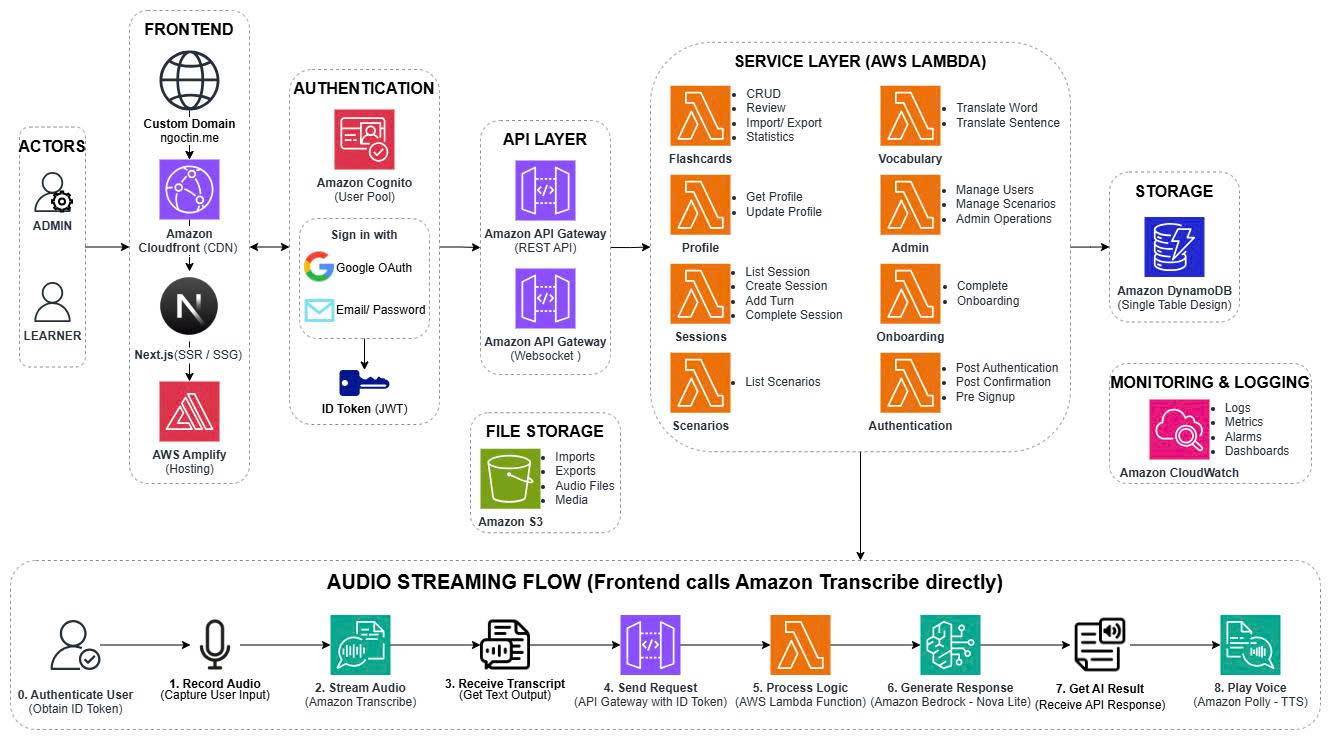
Main Components
1. Frontend (Next.js + Amplify)
- Framework: Next.js 15 with App Router
- UI Library: Shadcn/ui
- Hosting: AWS Amplify
- Features:
- Real-time speaking practice via WebSocket
- Flashcard management with SRS algorithm
- Progress dashboard
- User profile management
2. Backend (Lambda + SAM)
23 Lambda Functions organized by functional modules:
Onboarding Module
CompleteOnboardingFunction- Complete initial user setup
Admin Module
ListAdminUsersFunction- Retrieve user listUpdateAdminUserFunction- Update user informationListAdminScenariosFunction- Retrieve scenario listCreateAdminScenarioFunction- Create new scenarioUpdateAdminScenarioFunction- Update scenario
Profile Module
GetProfileFunction- Retrieve user profileUpdateProfileFunction- Update user profile
Flashcard Module (SRS)
CreateFlashcardFunction- Create flashcardListFlashcardsFunction- List flashcardsListDueCardsFunction- Retrieve due cards for reviewReviewFlashcardFunction- Process card review (SM-2 algorithm)GetFlashcardFunction- Retrieve card detailsUpdateFlashcardFunction- Update flashcardDeleteFlashcardFunction- Delete flashcardExportFlashcardsFunction- Export cards (CSV/JSON)ImportFlashcardsFunction- Import flashcardsGetStatisticsFunction- Retrieve learning statistics
Speaking Module (AI + Voice)
SpeakingWebSocketFunction- WebSocket connection handlerSpeakingSessionFunction- Manage speaking sessions
Vocabulary Module
TranslateVocabularyFunction- Translate individual wordsTranslateSentenceFunction- Translate sentences
Scenarios Module
ListScenariosFunction- List public scenarios
3. Database (DynamoDB)
Single-Table Design with LexiApp table:
Partition Key: PK (e.g., "USER#user-id", "FLASHCARD#card-id")
Sort Key: SK (e.g., "PROFILE", "CREATED#timestamp")

Global Secondary Indexes (GSI):
- GSI1: PK=GSI1PK, SK=GSI1SK
- GSI2: PK=GSI2PK, SK=GSI2SK
- GSI3: PK=GSI3PK, SK=GSI3SK
- GSI4: PK=GSI4PK, SK=GSI4SK
- GSI5: PK=GSI5PK, SK=GSI5SK
Index Purposes:
- GSI1: User-based queries
- GSI2: Time-based queries
- GSI3: SRS - due cards retrieval
- GSI4: Admin queries
- GSI5: Analytics queries
4. Authentication (Cognito)
- User Pool:
LexiUserPool-prod(ap-southeast-1_I9ri7n518) - Lambda Triggers:
PreSignUp- Auto-confirm email verificationPostConfirmation- Create user profilePostAuthentication- Log login events
5. AI & Voice Processing
Amazon Bedrock (Claude 3 Haiku)
- AI-powered conversation for speaking practice
- Provides feedback on grammar, pronunciation, and vocabulary
- Cost: ~$0.25/1M input tokens
Amazon Transcribe
- Speech-to-Text (STT) conversion
- Supports English and Vietnamese
- Cost: ~$0.024/minute
Amazon Polly
- Text-to-Speech (TTS) synthesis
- Neural voice technology
- Cost: ~$0.02/1K characters
Amazon Comprehend
- Natural language analysis
- Analyzes sentence structure and keywords
- Cost: ~$0.0001/unit
6. Storage (S3)
- Bucket:
lexi-be-speakingaudiobucket-* - Purpose: Store speaking practice audio files
- Encryption: AES-256 server-side encryption
- CORS: Configured for frontend access
7. API Gateway
REST API
- Endpoint:
https://mnjxcw3o1e.execute-api.ap-southeast-1.amazonaws.com/Prod/ - Authentication: Cognito Authorizer
- Routes: /flashcards, /profile, /sessions, /admin, /scenarios
WebSocket API
- Endpoint:
wss://{api-id}.execute-api.ap-southeast-1.amazonaws.com/Prod - Purpose: Real-time speaking session communication
- Routes: $connect, $disconnect, $default
Speaking Practice Flow
| Step | Description |
|---|---|
| 1 | User establishes WebSocket connection |
| 2 | Frontend streams audio to backend (Transcribe) |
| 3 | Lambda receives audio → Transcribe converts to text |
| 4 | Lambda sends text + context → Bedrock (AI) |
| 5 | Bedrock generates feedback response |
| 6 | Lambda synthesizes response → Polly (TTS) |
| 7 | Lambda sends audio response to frontend |
| 8 | Frontend plays audio response to user |
| 9 | Session data persisted to DynamoDB |
Flashcard SRS Flow
| Step | Description |
|---|---|
| 1 | User requests list of cards due for review |
| 2 | Lambda queries DynamoDB (GSI3) |
| 3 | Returns cards based on SM-2 algorithm |
| 4 | User reviews flashcard |
| 5 | User selects: Easy / Good / Hard / Again |
| 6 | Lambda calculates next review date (SM-2) |
| 7 | Card updated in DynamoDB |
| 8 | Learning statistics updated |
Operating Costs (Estimated)
Development Stage (100 users)
| Service | Cost/month |
|---|---|
| Lambda | $0.44 |
| DynamoDB | $0.02 |
| S3 | $1.28 |
| API Gateway | $0.19 |
| Bedrock | $5.00 |
| Transcribe | $2.40 |
| Polly | $0.20 |
| Comprehend | $1.00 |
| Translate | $1.50 |
| Total | $12.03 |
Growth Stage (500 users)
| Service | Cost/month |
|---|---|
| Lambda | $2.20 |
| DynamoDB | $0.10 |
| S3 | $6.40 |
| API Gateway | $0.95 |
| AI/ML Services | $50.00 |
| Total | $59.65 |
Clean Architecture
Backend organized in 5 layers:
1. Domain Layer (src/domain/)
Core business logic - Independent from other layers
- Entities: Flashcard, Scenario, Session, Turn, UserProfile, Vocabulary, Scoring
- Value Objects: Character, Enums (DifficultyLevel, ReviewQuality, SessionStatus)
- Domain Services:
- SRS Engine (Spaced Repetition System)
- Speaking Performance Scorer
- Conversation Orchestrator & Analyzer
- Prompt Builder & Validator
- Model Router, Greeting Generator
- Metrics & Cost Aggregator
- CloudWatch Dashboard Builder
- Domain Exceptions: Dictionary exceptions
2. Application Layer (src/application/)
Use cases and business workflows - Depends on Domain
- Use Cases: Admin, Flashcard, Onboarding, Profile, Scenario, Speaking, Vocabulary
- DTOs: Auth, Flashcard, Onboarding, Profile, Speaking, Vocabulary
- Repository Interfaces: FlashCard, Scenario, Scoring, Session, Turn, UserProfile
- Service Ports: Dictionary, LLM Scoring, Speaking Services, Translation
- Validators: Onboarding validators
- Exceptions: Application, Auth, Flashcard, Vocabulary errors
3. Infrastructure Layer (src/infrastructure/)
Repository and service implementations - Depends on Application
- Handlers: Lambda handlers (Admin, Auth, Flashcard, Onboarding, Profile, Speaking, Vocabulary)
- Persistence: DynamoDB repositories (Flashcard, Metrics, Scenario, Scoring, Session, Turn, User)
- Services: AWS Translate, Bedrock Scorer, Cache, Retry, Speaking Pipeline, Transcribe
- Adapters: Dictionary Service Adapter
- Configuration: Config, Logging
- Factories: Repository Factory, Service Factory, Handler Factory
4. Interfaces Layer (src/interfaces/)
API contracts and presentation logic - Depends on Application
- Controllers: Admin, Auth, Flashcard, Onboarding, Profile, Scenario, Session, Vocabulary
- View Models: Admin, Flashcard, Onboarding, Scenario, Session, User, Vocabulary
- Mappers: Auth, Flashcard, Onboarding, Profile, Session, Vocabulary
- Presenters: Base, HTTP Presenter
5. Shared Layer (src/shared/)
Common utilities - Independent from other layers
- HTTP Utils: Response formatting, error handling
- Result: Result pattern (Success/Failure)
- ULID Util: ID generation
Dependency Flow
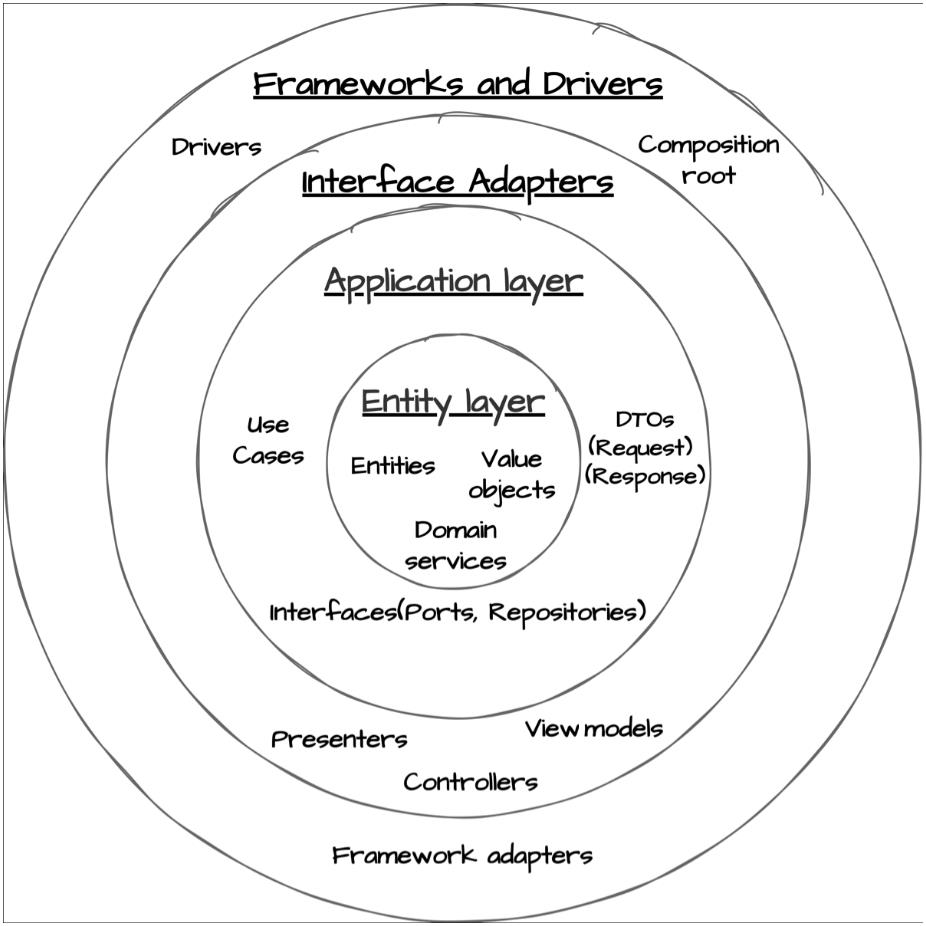
Principles:
- Domain layer has no dependencies on other layers
- Application layer depends only on Domain
- Infrastructure implements interfaces from Application
- Interfaces orchestrate use cases from Application
- Shared utilities used across all layers
Deployment Strategy
CloudFormation Stacks
- lexi-database - DynamoDB table
- lexi-auth-base - Cognito User Pool
- lexi-auth-lambdas - Cognito Lambda Triggers
- lexi-auth-providers - OAuth providers (future)
- lexi-be - Main application (Lambda, API Gateway, S3)
Deployment Order
| Order | Stack | Description |
|---|---|---|
| 1 | lexi-database | DynamoDB table |
| 2 | lexi-auth-base | Cognito User Pool |
| 3 | lexi-auth-lambdas | Auth Lambda triggers |
| 4 | lexi-be | Main application (Lambda, API Gateway, S3) |
| 5 | Frontend | Amplify deployment |
Checklist
After reviewing this overview, you should:
- Understand Lexi’s serverless architecture
- Know the main components (Lambda, DynamoDB, API Gateway, Cognito, S3)
- Understand the speaking practice flow
- Understand the flashcard SRS flow
- Know the estimated operating costs
- Understand the backend’s Clean Architecture
- Know the deployment strategy
Next Steps
Continue to Prerequisites & Setup to begin deployment.